

Reviews
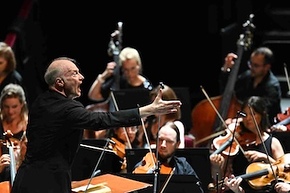
Beethoven - Symphony No.9 'Choral' - BBC Philharmonic Orchestra conducted by Gianandrea Noseda, BBC Proms
...the Philharmonia Chorus were on blazing form.
Ivan Hewett, The Telegraph, 21 July 2026
....the finale featuring an exceptionally robust Philharmonia Chorus.
Daniel Lewis, The Times, 22 July 2026
....we had the 118 strong Philharmonia Chorus, strong and firm and projecting cleanly.
David Guttman, Classical Source, 20 July 2026
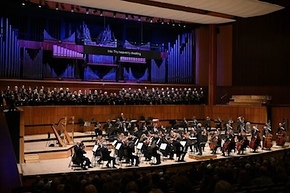
Taneyev - John of Damascus - Royal Philharmonic Orchestra conducted by Vasily Petrenko
This was another fine concert from Vasily Petrenko and the Royal Philharmonic Orchestra....The women's voices entered first, joined by the men in a long crescendo towards a powerful, almost overwhelming climax. Petrenko built a performance of considerable intensity from his singers and players: and what a sound the Philharmonia Chorus makes!....It was a fine performance, though there can be no doubt that the collective hero of the hour was the Philharmonia Chorus, singing with dramatic immediacy and stinging force.
Chris Kettle, Seen and Heard International, 20 May 2026
Hildegard of Bingen - O vis aeternitatis
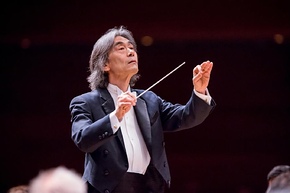
Mahler - Symphony No.2 'Resurrection' - Philharmonia Orchestra conducted by Kent Nagano
...the Philharmonia Chorus sang with superb control.
Rebecca Franks, The Times, 20 March 2026
....with Hildegard von Bingen's spare and sinuous O vis aeternitas sung by a semi-chorus processing slowly through the auditorium, their voices wreathing the hall like a trail of incense.
The mighty Philharmonia Chorus have made the big, middle-European romantic sound their own and their exhortation to "Rise again" as the final movement got underway revealed a whole new dimension in sound.
Eleanor Knight,
Bachtrack, 21 March 2026
But it was Nagano that choreographed the great choral climax so perfectly, the Philharmonia Chorus beautifully soft on entry, the male voices later creating an imposing wall of sound, Nagano extending the silent pause after 'Bereite dich' daringly, as if himself asking, 'Prepare yourself for what?'. 'To live,' came the answer, and how beautifully Archibald crowned the chorus. The Philharmonia Chorus could only be described as fearsomely present in the work's final stretch; and yet the brass crowned it all, perfectly. Good to hear the RFH organ at full tilt, too.
Colin Clarke, Classical Explorer, 22 March 2026
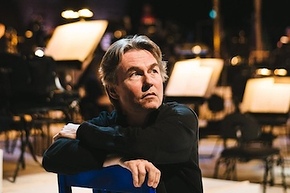
Ravel - Daphnis et Chloé - Philharmonia Orchestra conducted by Esa-Pekka Salonen
The chorus were magnificent in setting up the evocation of dawn.
David Karlin, Bachtrack, 26 February 2026
...the drama as well as the yearning erotic heat of the music came across with fabulous, ear-drenching magnificence.
Ivan Hewett, The Telegraph, 26 February 2026
The hushed opening of Act I was magical, with harps, muted horn, and flute emerging over barely audible strings. Luxuriant crescendos, including the incisive entries of the chorus, were overwhelming. The swelling
Danse religieuse was orgiastic in its abandon and there was a modern, almost jazzy swing to the youths and maidens' Danse Générale. Along the way, Salonen was an eloquent advocate for the linking sections you don't get to hear when, as is usually the case, the ballet is given incomplete. In Act III, Salonen conjured a Mediterranean warmth and an ideal balance with the chorus for the famous Lever du jour (Sunrise). A lovely flute solo for the pantomime of Pan and Syrinx followed, before players and singers rose together with an ecstatic shout of joy in the concluding Bacchanale. A truly memorable performance.
Clive Paget,
Musical America, 27 February 2026
The memorable moments were played by Samuel Coles (flute) and Rebecca Kozam (cor anglais); and not forgetting the Philharmonia Chorus who were 'ethereal-erotic' throughout: luminous
and voluptuous. However, the concluding Danse générale was just loud and brash which nevertheless was guaranteed to bring the (packed) house down: and it did with an ecstatic aplomb!
Alexander Verney-Elliott, Seen and Heard International, 27 February 2026
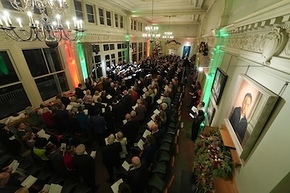
An Evening of Carols at the MCC
I launched my personal carol season at Lord's on December 1st with some absolute bangers led by the incredible Philharmonia Chorus.
Kate Mason, Metro, 19 December 2025
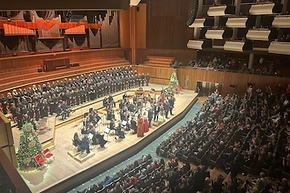
Handel - Messiah - Orchestra of the Age of Enlightenment conducted by Eamonn Dougan
There is, of course, a long tradition in this country of Christmas Messiah performances but it's not one I've ever previously participated in. This was the first time I've ever heard Messiah live, despite being quite long in the tooth, and it was terrific. I can see what I've been missing out on all these years. Handel really knew what he was doing, as do the Philharmonia Chorus, the Orchestra of the Age of Enlightenment and four excellent soloists, all under the leadership of Eamonn Dougan.
I am no expert on the scholarship behind performance practice of Messiah, although the piece is clearly robust enough to work in any number of types of presentation. What we had last night was something of a hybrid approach: small period-instrument band but large choir (numbering around a hundred). But no weighty choral-society warbling here. Eamonn Dougan encouraged a lightness of approach in his pithy, agile gestures, and the Philharmonia Chorus responded in kind, the sopranos in particular flying fluently through their many melodic runs. The final chorus saw the entire choir in glorious, summatory voice. Elsewhere, they were feisty in "He trusted in God" and generous in "wonderful.....counsellor" from "For unto us a child is born".
Bernard Hughes, The Arts Desk, 13 December 2025